
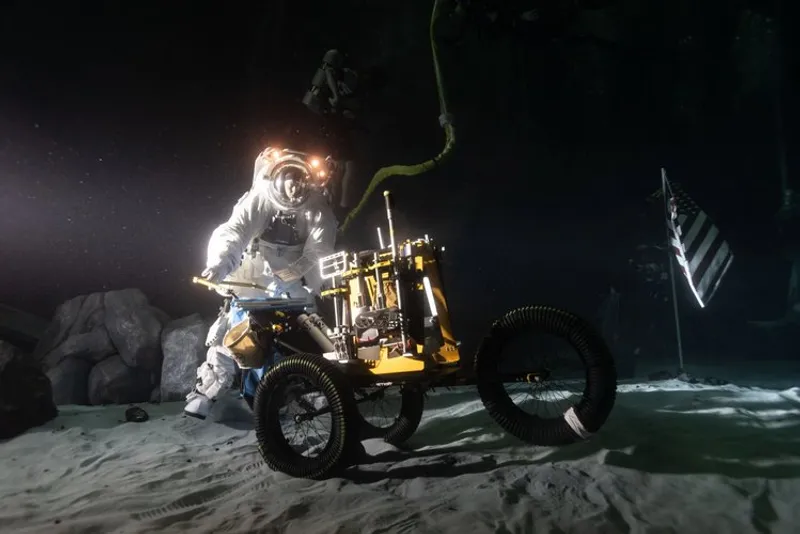
TLDR: HOUSTON—Scott Wray, Artemis EVA training lead at NASA Johnson Space Center, oversees lunar suit and field science training for xEMU EVAs after decades shaping spacewalk instruction.
Key Takeaways:
- Wray grew up staging Apollo style hops, then joined NASA through the Contractor Co op Program at Johnson Space Center.
- He helped build EVA repair procedures from STS 117 shuttle work and later recalls a July 2013 space station helmet leak.
- Artemis training now blends lunar South Pole lighting, suited mobility systems, and geology so astronauts walk as field scientists on the Moon.

The job looks like choreography in a pool, but Wray treats it like field survival engineering. Artemis EVA training aims to turn suit quirks and Moon science into muscle memory before first steps.
The job looks like choreography in a pool, but Wray treats it like field survival engineering. Artemis EVA training aims to turn suit quirks and Moon science into muscle memory before first steps.
Q&A
Why does “walking instead of translating” force a rethink of spacesuit training even for experienced spacewalkers?
Moon surface mobility changes where forces land and how joints and hand controllers get used, so instructors must rebuild movement strategies and caution responses from the ground up.
What does the July 2013 spacesuit helmet leak incident imply about designing training for rare failure modes?
It signals that even seasoned crews can face unseen failure paths, so training must stress vigilance, rapid diagnosis, and practice scenarios that recreate ambiguous leaks and limited control.
How could lunar South Pole lighting testing reshape daily EVA planning beyond visibility?
Lighting affects contrast, shadows, and instrument readability, which can change how astronauts approach sequencing, tool handling, and safe traverse decisions under harsh conditions.
What is the deeper value of integrating geology into EVA flows rather than treating it as a separate class?
Field science depends on movement accuracy, sampling timing, and communication under constraints, so the curriculum can align scientific goals with real operational pacing.
Why does Wray emphasize equipment and curriculum that fit different body types and backgrounds as the astronaut corps evolves?
If techniques and tools assume one “default” user, performance gaps can appear under stress; designing for individual strengths supports consistency, resilience, and teamwork during complex EVAs.
Top in Space

FAA clears SpaceX Starfall reentries, betting on space manufacturing

Moon quarantine plan targets Mars sample contamination fears

Blue Origin failure adds heat to NASA lunar timeline
Blue Origin targets New Glenn return after pad explosion

No comments yet. Be the first to share your thoughts!