
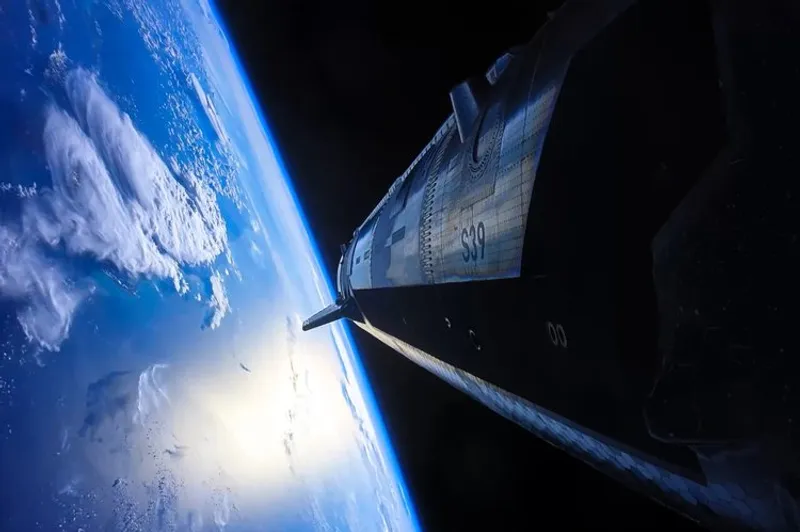
TLDR: LOS ANGELES—The FAA approved Starfall test flights for SpaceX, including two reentries into the Pacific off California. Disk shaped capsules will enable microgravity R and D and point to point cargo.
Key Takeaways:
- Space based manufacturing leans on microgravity to create materials and components that are difficult or impossible on Earth, with Varda Space Industries pushing early prototypes.
- Starfall capsules are 10.2 feet wide and 2.5 feet tall, carrying up to 2,205 pounds, using an aluminum top plate and carbon fiber heat shield during reentry.
- SpaceX’s reusable launch access could lower the barrier for in orbit manufacturing and cargo services, but the timeline and follow on missions remain unclear.

Microgravity has long sounded like science fiction. Starfall is the first concrete step toward making it a logistics business, with reentry recovery and launch flexibility as the real competitive edge.
Microgravity has long sounded like science fiction. Starfall is the first concrete step toward making it a logistics business, with reentry recovery and launch flexibility as the real competitive edge.
Q&A
Why does FAA approval matter more for a manufacturing capsule than for a one time research mission?
It signals confidence in safety and reentry operations for repeated flights, which is what manufacturing contracts need: cadence, reliability, and predictable recovery.
What would make Starfall more commercially valuable than simply doing research in space labs?
If SpaceX can prove that materials produced in microgravity translate into higher performance or lower costs on Earth, the capsule becomes a production pipeline, not a science platform.
How does the 2,205 pound payload cap shape who can use Starfall first?
It pushes initial customers toward firms that can justify bulk experiments or hardware shipping, not just small research samples, which could narrow early demand.
What happens if reentry recovery proves harder than planned, even after FAA clears tests?
Any drop in capsule retrieval reliability would quietly raise customer risk, forcing SpaceX to spend more on recovery systems or to sell shorter term research packages instead of long term manufacturing.
Why might competitors struggle even if they build similar capsules?
Access to frequent orbit launches drives iteration speed, and SpaceX’s rocket fleet reduces the friction competitors face when they depend on third party launch capacity.
Top in Space

Moon quarantine plan targets Mars sample contamination fears

Scott Wray readies Artemis EVAs for lunar realities

Blue Origin failure adds heat to NASA lunar timeline

Blue Origin targets New Glenn return after pad explosion

No comments yet. Be the first to share your thoughts!