
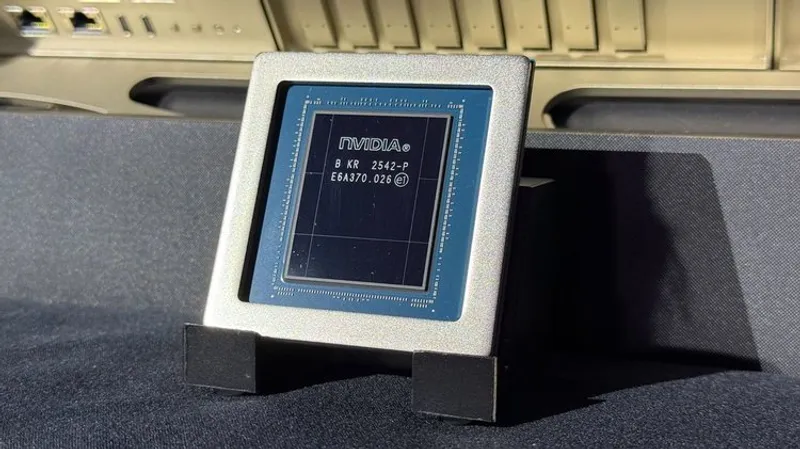
TLDR: SANTA CLARA, Calif.—Nvidia let Phoronix run Linux benchmarks at its Santa Clara site on an 88 core Vera CPU with a custom Olympus core, showing strong competitiveness versus AMD EPYC Turin and Intel Xeon Granite Rapids, though it is based on a limited workload set.
Key Takeaways:
- Phoronix tested Nvidia Vera in curated Linux benchmarks at Nvidia headquarters in Santa Clara, comparing against AMD EPYC Turin and Intel Xeon Granite Rapids platforms across compilers and server workloads.
- Vera uses a custom Olympus core for ARM instruction set compatibility, and in kernel builds and per thread results it stays close to or beats x86 rivals in benchmarks like LuaJIT FFTs, ClickHouse, and Renaissance JVM.
- Nvidia restricted the benchmark scope and key power efficiency measurements were not directly tested, with Vera listed at 450W TDP plus 50W memory, raising questions for AI data center deployment.

The first Vera numbers feel less like a science project and more like a dare: can a custom Arm core hold its own against x86 in real server software. The lingering gap is power and scaling beyond Nvidia curated tests.
The first Vera numbers feel less like a science project and more like a dare: can a custom Arm core hold its own against x86 in real server software. The lingering gap is power and scaling beyond Nvidia curated tests.
Q&A
If Vera is strong in curated Linux workloads, what benchmark types could still flip the outcome against EPYC or Xeon?
The next swing is likely in wider mixed services, heavier thread scaling, and workloads with different memory access patterns, where x86 designs often show different bottlenecks than compilers, encoders, and selected databases.
Why does “performance per core” matter even when total throughput looks great?
For operators, density and binning decisions depend on how much useful work each core delivers under real constraints. High total scores can still hide lower efficiency per core in latency sensitive or bursty jobs.
Nvidia says Vera has upstream open source support. What practical impact does that have for early adoption?
Upstream Linux support reduces driver and kernel maintenance headaches, which lowers time to deploy and makes it easier for toolchains, observability stacks, and performance tuning to work out of the box.
How could power efficiency turn from an afterthought into a dealbreaker for Vera in AI datacenters?
If real system power ends up closer to higher end x86 platforms once you include memory, interconnect, and cooling realities, infrastructure limits could cap cluster growth even when raw benchmark performance looks competitive.
What historical pattern would you watch for with custom server CPU cores like Vera and earlier Nvidia designs?
The key precedent is whether hardware momentum and software ecosystem maturity track together. Even strong cores can stall if runtimes, compilers, and tuning utilities lag behind deployment needs.





No comments yet. Be the first to share your thoughts!