
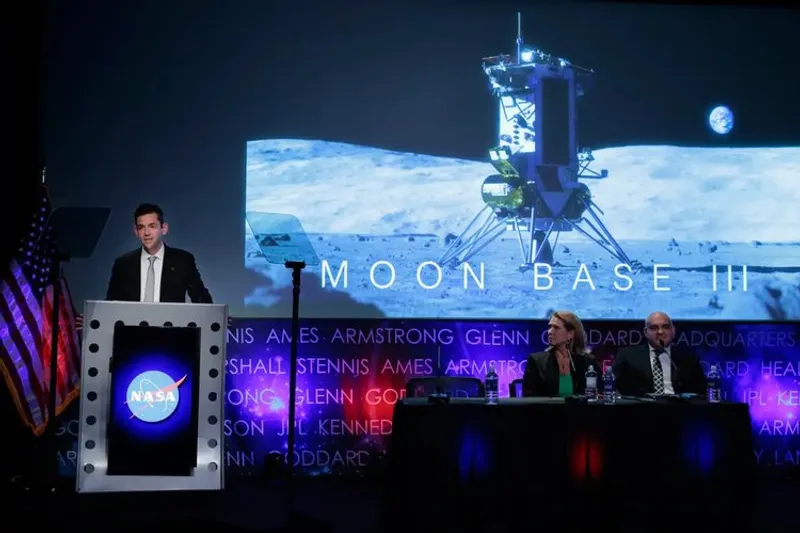
TLDR: WASHINGTON—NASA laid out a lunar base timeline starting with uncrewed Moon Base I through 2036 near the lunar south pole, targeting first three missions this year. NASA aims to secure reliable access by 2029 and build initial operating capability by 2032, using scouting rovers, drones, and private landers.
Key Takeaways:
- Artemis has focused on returning humans to the moon; a permanent base now moves from concept to a phased construction plan.
- NASA targets Moon Base I, II, and III for this year, with landers from Blue Origin, Astrobotic, and Intuitive Machines.
- The base near the lunar south pole grows to hundreds of square kilometers by the final phase, but power, shielding, and construction remain unclear.

NASA is shifting from moon landings to moon logistics, with private landers and autonomous scouts doing the hard reconnaissance work. The calendar looks firm, but the big engineering answers still feel like they are waiting in the dark.
NASA is shifting from moon landings to moon logistics, with private landers and autonomous scouts doing the hard reconnaissance work. The calendar looks firm, but the big engineering answers still feel like they are waiting in the dark.
Q&A
What needs to be proven before NASA can safely build anything close to a real base near the lunar south pole?
NASA needs sustained surface mobility, precise landing and site characterization, plus dependable power and radiation protection concepts that survive long lunar day night cycles.
Why does NASA start with uncrewed Moon Base missions instead of sending astronauts early?
Risk management matters more than prestige here, and scouting rovers and drones can validate terrain, comms, and landing hazards without exposing crews to unknowns.
How do private companies like Blue Origin, Astrobotic, and Intuitive Machines change NASA accountability?
They shift schedule pressure and technical responsibility to commercial providers, while NASA must still integrate results into a single architecture for vehicles, operations, and safety.
If shielding and power details are still missing, what is NASA likely to prioritize first?
NASA will likely treat survival systems as the integration bottleneck, pushing early work on power generation options, habitat protection strategies, and surface logistics.
What happens next after terrain scouting missions like MoonFall generate candidate landing sites?
NASA will have to narrow choices into repeatable landing zones, then align future landers and cargo routes so construction can scale beyond one off site and one off landing.





No comments yet. Be the first to share your thoughts!