
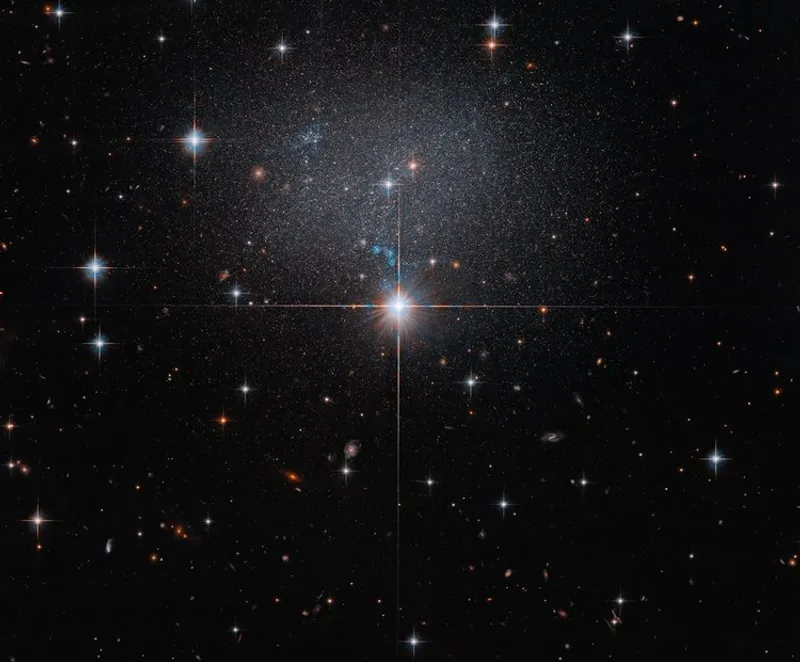
TLDR: GREENBELT, Md.—Hubble imaged ESO 490-017, a 12,000 light year dwarf irregular galaxy 23 million light years away. The data supports distance measurements using low mass red giants.
Key Takeaways:
- ESO 490-017 sits in Canis Major, where its low surface brightness hides it behind foreground star glare.
- Hubble measured distances by treating low mass red giant stars as standard candles in an observing program of galaxy and cluster motion.
- Those distances help chart the cosmic flow driven by uneven matter, while also building a legacy archive of local star types.

Even when a galaxy looks like background noise, Hubble can still turn it into a reliable ruler. The trick is not just seeing the faint glow, but measuring the right stars inside it.
Even when a galaxy looks like background noise, Hubble can still turn it into a reliable ruler. The trick is not just seeing the faint glow, but measuring the right stars inside it.
Q&A
Why do Hubble’s distance estimates lean on low mass red giants instead of brighter stars?
Low mass red giant stars provide steadier luminosity benchmarks, letting researchers infer distances more reliably than unpredictable brightness spikes from other objects.
How does a “cosmic flow” map change the way scientists think about where mass sits in the universe?
If galaxies move faster or slower than expected, the pattern points to the gravitational pull of unseen matter, tightening models of large scale structure.
What makes a low surface brightness galaxy like ESO 490-017 so hard to catch in ordinary images?
Its light spreads thinly across the sky, so brighter foreground stars and their diffraction spikes can visually swamp the galaxy’s glow.
Why does an image full of background galaxies matter for a study focused on ESO 490-017?
Deep fields reveal many distant systems at once, which improves the context of the region and supports comparison across redshifts and structures.
What should researchers do next with this kind of Hubble legacy dataset?
They can revisit stored measurements to refine stellar catalogs in nearby galaxies and cross check distance and motion models as analysis methods improve.




No comments yet. Be the first to share your thoughts!