
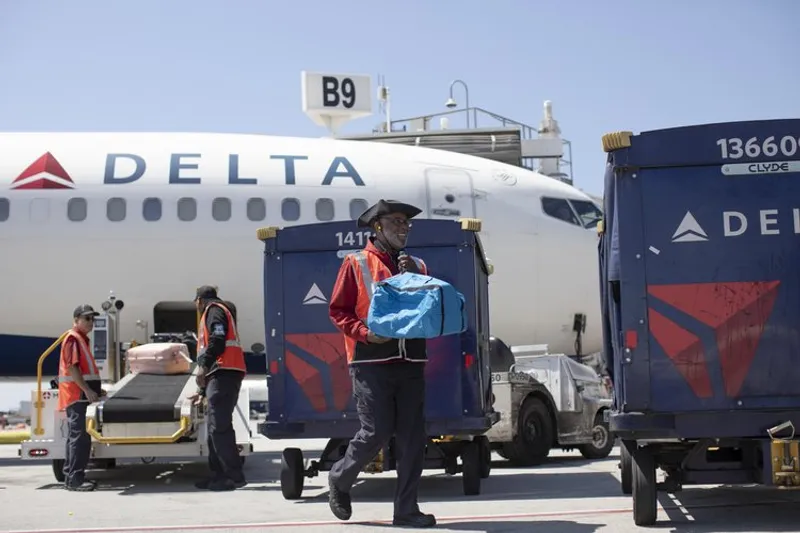
TLDR: ATLANTA—At Hartsfield-Jackson Atlanta International Airport, Delta moves over 100,000 bags a day, using AI to sequence deliveries for tug drivers handling hot and cold bags.
Key Takeaways:
- Atlanta is Delta’s largest hub, where ramp work connects gates to tarmac and, during peak travel, millions of bags must flow fast and precisely.
- Delta built AI for tug drivers to prioritize bag routes and cut misordering, and says it boosted baggage transfer success rates by up to 20%.
- AI still depends on real time chaos: drivers report “hot bags” with as little as 20 minutes can succeed, but tight connections can remain out of their control.

The ramp looks like muscle and headsets, but Delta’s brag is about rhythm. AI handles the order, humans handle the sprint, and passengers hope the math holds.
The ramp looks like muscle and headsets, but Delta’s brag is about rhythm. AI handles the order, humans handle the sprint, and passengers hope the math holds.
Q&A
How does Delta balance AI optimized routing with unpredictable gate changes during storms, delays, or aircraft swaps?
The AI can prioritize bag delivery order, but it still has to react when gates shift and planes arrive late. Delta’s process relies on human drivers scanning tags and following updated instructions in real time.
If AI improves transfer success by up to 20%, what part of the work does it most directly fix versus only assist?
Delta frames the improvement as better consistency in delivery order rather than removing decision making entirely. Scanning, sequencing, and getting to the right gate in the right order are the parts the AI targets.
Why do “hot bags” keep generating pressure even when routing software gets smarter?
Hot bags depend on how much time is actually left after the last operational hiccup. Even with perfect sequencing, a late arrival or last minute connection cut can still compress reality beyond what any driver can control.
What happens to baggage flow when Delta expands the same AI system to Detroit and Minneapolis-Saint Paul later this year?
The company’s plan implies it expects similar benefits where tug traffic patterns resemble ATL’s. Those hubs still differ in layout and volumes, so performance could vary based on local ramp geometry and operational timing.
Could competitors copy Delta’s approach without matching its scale and data pipeline?
Delta’s system likely depends on large scale operating history from a massive hub. Smaller airlines may need longer data collection and process standardization before the same gains appear.
Top in AI

Jensen Huang pushes Nvidia investment to Taiwan’s AI epicenter

Developers hit AI answer loops on GitHub and beyond

SpaceX admits chip shortage threatens orbital AI scaling

Android users doubt Gemini Intelligence as Google ramps agents

No comments yet. Be the first to share your thoughts!