
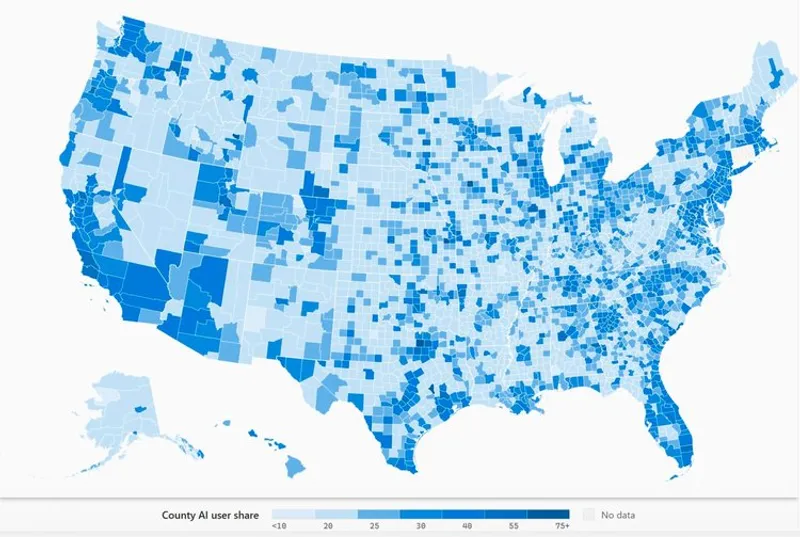
TLDR: WASHINGTON—Microsofts U.S. AI Diffusion Report tracks AI use across 3,100 counties and 50 states, with Texas leading. It highlights a 16.8 point urban rural gap, even after adjusting for age and income.
Key Takeaways:
- Technologists expected AI to cluster in San Francisco, Seattle, New York, and Boston, but Microsoft mapped adoption across 3,100 counties.
- Texas ranks fourth at 35.4% AI use, ahead of California at 34.1%. District of Columbia leads at 40.6%, while West Virginia trails at 20.8%.
- Metro counties average 33% AI use versus 16.2% rural, a persistent 16.8 point divide that may widen productivity and wage gaps.

The surprise is not that big tech is using AI. It is that the map looks like America learning a new tool in real workplaces, while rural areas get left holding the paper manuals.
The surprise is not that big tech is using AI. It is that the map looks like America learning a new tool in real workplaces, while rural areas get left holding the paper manuals.
Q&A
If AI adoption predicts productivity, what will local leaders do differently in metro counties versus rural counties?
Expect faster employer rollouts and faster training in metro areas, while rural governments and small businesses may focus on subsidies, broadband, and managed AI services to catch up.
Why might Texas outperform California even though many AI models start elsewhere?
Adoption can lag creation. A state with rapid population growth and business expansion may convert tools into day to day workflows sooner than a more saturated tech hub.
What does the college town spike suggest about the next wave of adoption?
AI use may travel with graduates and returning students, turning universities into distribution networks for templates, prompts, and employee training.
What could shrink the urban rural gap if it persists after controlling for age and income?
Infrastructure alone may not be enough. Streamlined procurement, local support programs, and simpler AI tools for small businesses may matter more than awareness campaigns.
Why do political sentiment surveys and behavior maps increasingly line up?
Policy signals, employer messaging, and community narratives can shape whether people trial AI tools. Over time, that feedback loop can reinforce adoption patterns.





No comments yet. Be the first to share your thoughts!