
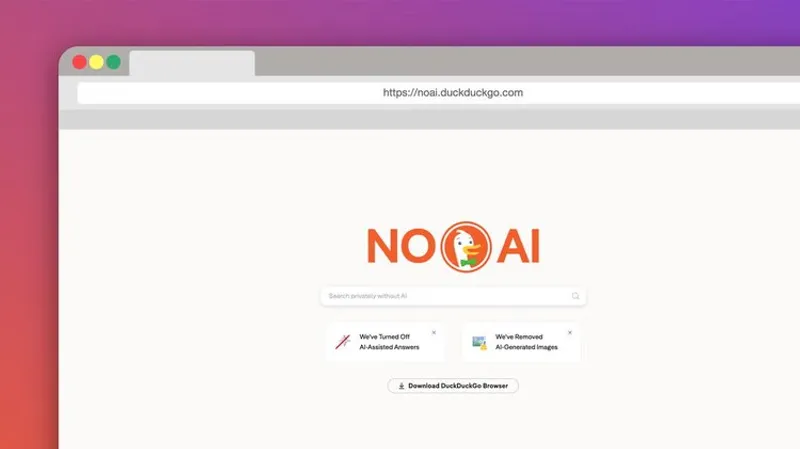
TLDR: SAN FRANCISCO—After Google unveiled an AI powered Search box at I O, DuckDuckGo reported a 27.7% jump in visits to its No AI search page and 30% US install growth week over week. Users cite privacy and hallucination concerns as they switch to a mode that turns off AI assisted answers and images.
Key Takeaways:
- Google’s I O Search upgrade pushed AI deeper into results, while DuckDuckGo leaned into opt out control.
- DuckDuckGo turned off AI assisted answers and removed AI images, calling it “search privately without AI” on its No AI page.
- Search behavior is shifting fast, with DuckDuckGo seeing 27.7% higher No AI visits and warning that forced AI can worsen results.
- Duck.ai adds choice, letting users pick six free LLM models and remove metadata, while paid options expand model access.

Google is betting that AI should be the default, but DuckDuckGo is selling the opposite feeling: the power to turn the noise off. The traffic math suggests people want AI, just not a leash.
Google is betting that AI should be the default, but DuckDuckGo is selling the opposite feeling: the power to turn the noise off. The traffic math suggests people want AI, just not a leash.
Q&A
What happens to user behavior when AI becomes unavoidable by design?
Some users will treat AI as a setting they bypass entirely, pushing demand toward search engines that clearly separate AI and non AI modes.
Could “No AI” become a standard feature rather than a differentiator?
If traffic shifts keep showing meaningful lift, competitors may add opt out toggles to reduce churn and keep users from defecting.
How might AI hallucination complaints shape future search product testing?
Teams could increase emphasis on citation quality, answer uncertainty signals, and user controls that limit AI output in early prototypes.
Why would metadata stripping matter for LLM quality and user trust at the same time?
Even if LLM performance stays similar, removing identity signals can boost confidence, which then drives more repeat usage and less experimentation fatigue.
What is the next competitive move once users split into AI and No AI search habits?
Expect tighter segmentation, such as separate result layouts, different rankings depending on mode, and clearer policy messaging about data retention and prompt usage.





No comments yet. Be the first to share your thoughts!