
AGILINK reframes dexterity as the contact problem at ICRA 2026
 Robotics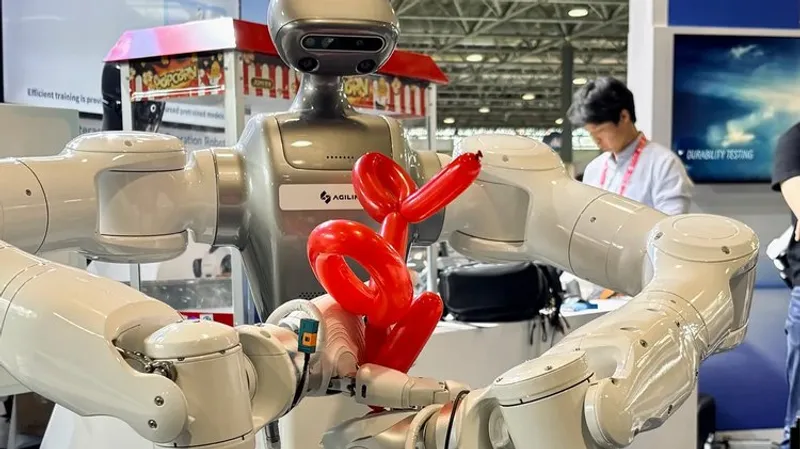
TLDR: VIENNA—At ICRA 2026 in Vienna, AGILINKs robot twisted a balloon dog without popping it, spotlighting force control and contact stability. The company pairs long horizon learning with tactile rich OmniHand sensing to tackle the hardest part after contact.
Key Takeaways:
- Balloon twisting combines deformable materials and long action sequences, exposing how small errors compound under real physical uncertainty.
- AGILINK built motion intelligence by learning from balloon artists and human mid drift recoveries, then trained contact intelligence from contact centric failures.
- The OmniHand 3 Ultra M adds direct drive force bandwidth and dense tactile sensing, aiming to keep robots inside the stability window where contact holds.
- Its demos tie to practical contact tasks like cable insertion, garment handling, flexible packaging, and delicate assembly.

The crowd loved the balloon dog because it looks effortless. Under the hood, AGILINK is basically saying that robotics fails in the quiet second when contact goes wrong.
The crowd loved the balloon dog because it looks effortless. Under the hood, AGILINK is basically saying that robotics fails in the quiet second when contact goes wrong.
Q&A
If contact intelligence is learned from real failures, how do robots avoid learning the wrong recovery habits from inconsistent human interventions?
AGILINKs approach records skilled corrections during drift toward failure, then folds those recoveries into reinforcement learning so the policy learns stable interaction patterns rather than just single successful motions.
Why does long horizon planning matter for contact tasks that seem like simple touch events?
Balloon twisting shows that each early twist sets geometry and internal pressure, so later contacts become feasible or impossible based on earlier action accuracy.
What has to improve for balloon like stability to transfer to tasks like connector mating or cable insertion?
Richer tactile sensing and faster force regulation must shrink the gap between detecting instability and correcting it, since real environments shift, deform, and change friction mid action.
Could more sensing alone solve contact instability, or is actuation equally critical?
The article argues both matter, because robots can only regulate what they perceive and must also react quickly enough, which direct drive is designed to enable.
What happens to robotics benchmarks if the field measures success by interaction stability instead of motion accuracy?
Evaluation would shift toward maintaining stable contact under changing geometry and friction, rewarding systems that adapt force distribution and slip tendencies, not just reach correct poses.
Top in Tech Trends

Computer Science Graduates Face Hiring Mismatch, Not a Dead Degree

Continuing education fights AI job churn and tech acceleration
Formlabs pushes Fuse X1 to make industrial SLS attainable

Bipartisan National Robotics Commission bill gains momentum in Congress

No comments yet. Be the first to share your thoughts!