
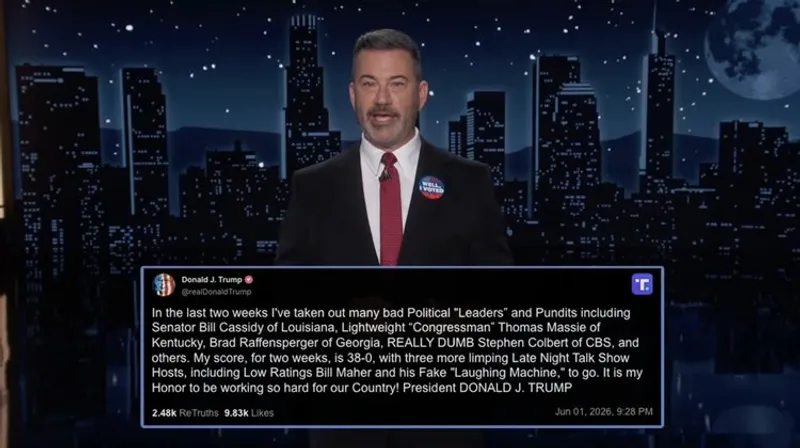
TLDR: LOS ANGELES—Jimmy Kimmel mocked Donald Trump’s Truth Social rant about late night hosts after Trump mentioned “taking out” Stephen Colbert. Kimmel linked it to his Peabody Award moment and laughed at Fox figures Laura Ingraham and Raymond Arroyo.
Key Takeaways:
- Kimmel has repeatedly traded barbs with Donald Trump, who often targets late night TV and its hosts.
- Kimmel responded to Trump claiming he has “three more limping” late night hosts after “taking out” Stephen Colbert, then riffed on a Peabody win.
- The exchange turns a TV honor into a culture war signal, keeping pressure on mainstream hosts and amplifying partisan media battles.

Trump keeps trying to make late night into a scoreboard, and Kimmel keeps treating it like one he already won. The bigger story is how quickly politics recruits TV’s awards season.
Trump keeps trying to make late night into a scoreboard, and Kimmel keeps treating it like one he already won. The bigger story is how quickly politics recruits TV’s awards season.
Q&A
Why does Trump’s attack on late night hosts keep landing, even when it is clearly about entertainment?
Late night functions as a high visibility target for political messaging, and Trump uses that attention to reinforce loyalty among supporters who already view these shows as adversaries.
What happens next when comedy hosts trade jokes with political figures directly on social platforms?
The audience moves from watching skits to tracking narratives in real time, which can increase both polarization and media engagement while shrinking room for nuance.
How might a major award like the Peabody change the stakes of a political back and forth?
Awards can shift the argument from personal insults to credibility, making the dispute less deniable and more likely to spread through mainstream and partisan media.
Why would Fox personalities join in when the original target is a different network?
Joining the call expands the coalition effect, turning one rant into a coordinated talking point that travels across channels and platforms.
Could this cycle eventually push late night into different content strategies?
If direct political targeting dominates, hosts may lean further into rapid response segments, meme sized headlines, and higher frequency commentary to stay competitive.



No comments yet. Be the first to share your thoughts!