
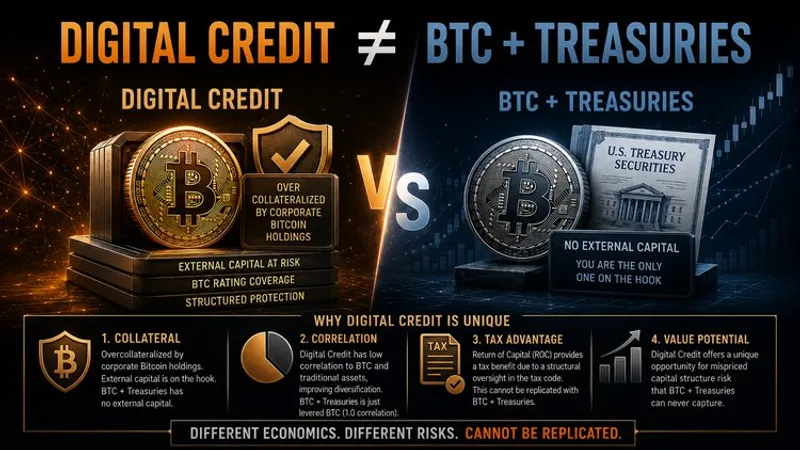
TLDR: A Bitcoin Magazine opinion argues Digital Credit cannot be replicated with Bitcoin and U.S. treasuries because STRC and SATA rely on overcollateralized issuer assets, diversification effects, and a unique return of capital tax profile that the simpler BTC plus treasuries trade cannot match.
Key Takeaways:
- Digital Credit products such as STRC and SATA face scrutiny after Onramp proposed a Bitcoin and treasuries “simpler trade” instead.
- The author cites four uniqueness drivers: overcollateralized corporate BTC, lower correlation metrics like STRC at 0.63 to BTC, and STRC ROC tax dynamics.
- If U.S. sovereign debt risk or tax rules shift, Digital Credit could reprice, while a pure BTC and treasuries portfolio would not carry the same idiosyncratic risk mix.
- The piece also challenges Onramp’s paper quality, calling out an error in its preface about an ad claiming the woman was an engineer.

The core claim is less about math bravado and more about who actually stands behind the structure. If STRC’s edge comes from corporate collateral and tax quirks, then copying the surface with BTC and treasuries is basically counterfeit engineering.
The core claim is less about math bravado and more about who actually stands behind the structure. If STRC’s edge comes from corporate collateral and tax quirks, then copying the surface with BTC and treasuries is basically counterfeit engineering.
Q&A
If Digital Credit’s advantage hinges on corporate collateral structure, what happens if issuer asset coverage or custody rules change?
Any shift in collateral coverage, seniority, or liquidity terms would likely alter the investor risk profile, which could push down the “unreplicable” premium the author argues markets may currently misprice.
Why does the author insist correlation matters when investors can already compare yields and volatility?
Lower correlation implies diversification benefits, so even when yields look similar, a BTC plus treasuries mix may fail to improve portfolio risk metrics the way a structured product can.
What makes return of capital risk different from ordinary price risk for holders of STRC and SATA?
Because ROC is tied to tax treatment and accounting behavior, it can change if tax rules change, creating a structural reprice even if underlying asset value moves in a predictable way.
How could a partial default scenario reshape the “treasuries are infinite collateral” assumption used in replication trades?
If debt policies shift selectively, the value and confidence in treasury cash flows would deteriorate, and the BTC plus treasuries approach would absorb that sovereign risk directly.
What would count as convincing proof on the replication question beyond backtesting returns?
A clean comparison that isolates collateral structure effects, correlation drivers, and tax treatment outcomes across stress periods would be needed to show whether the unique idiosyncratic factors really vanish under a BTC plus treasuries proxy.
Top in Crypto

Google engineer accused of Polymarket insider trading bets

Google engineer charged after Polymarket bet profit hinges on data

Google employee arrested over Polymarket insider bets
Bitcoin slips below $73,000 as Trump pushes CLARITY Act

No comments yet. Be the first to share your thoughts!